

Blue Origin sent some celebrities to space this week. Katy Perry was there. Some sports broadcaster. A French guy, I think? They got into matching jumpsuits, climbed into a penis-shaped capsule, and gently bounced off the edge of the sky while cameras rolled. It was framed as history. It looked like content.
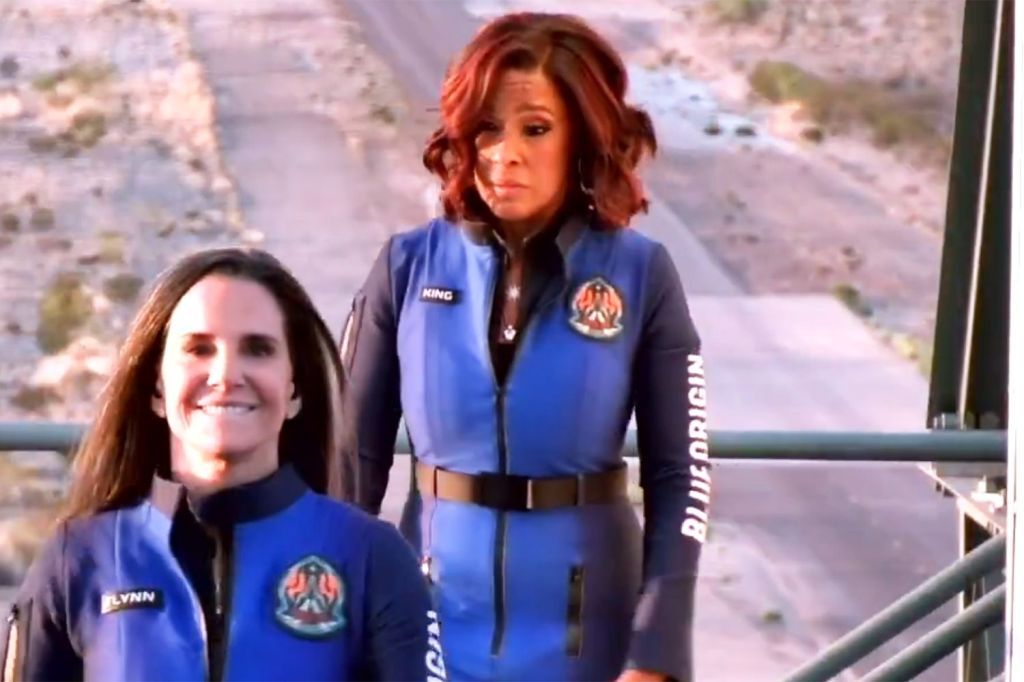
I know I’m supposed to be impressed. But I’m not. I did enjoy Gayle’s faces—her whole vibe was deeply relatable: the stressed face of someone wondering why they’re voluntarily being yeeted into the void. This picture of her looking mildly terrified is the only piece of space tourism I’ve ever emotionally connected with.
I’ve never cared about space. But then I’ve never felt like a stranger in a strange land. Not when I was a kid. Not when I read Robert A. Heinlein in high school. Not even when Interstellar tried to make the concept of fifth-dimensional time manipulation feel like a Christopher Nolan family drama. The only thing I hate more than space is multiverse storytelling, and Interstellar somehow managed to be both: cold, convoluted, and full of men whispering about love as a quantifiable force. It’s like if a TED Talk fell asleep during physics class and woke up crying.
All great male writers should be insouciantly thinking about the sea—melancholic, windswept, vaguely haunted. Melville had the decency to get obsessed with a whale. Meanwhile, Musk is trying to name a city on Mars after himself. All the dorkiest billionaires are fantasizing about space travel, white-knuckling their way into the void like it’s a product launch. It’s telling, really. The sea, at least, makes me feel something. A little awe, a little fear, a deep respect. It demands attention, not admiration. It doesn’t pretend to be our salvation. Just a reminder we’re not in charge.
Emily Ratajkowski—yes, that one—posted a TikTok calling the whole Blue Origin mission “a ridiculous waste of money,” and I haven’t been able to stop thinking about how refreshing it was to hear someone just say it. The truth is, the materials and money that go into space tourism are staggering—frankly, irresponsible when we’re facing crises here on Earth. But I’m not an expert on aerospace economics or carbon impact, so I’ll stick to what I know: vibes. And space tourism has bad ones. It makes space feel smaller, somehow—less like a frontier, more like a showroom. At least the sea still feels unknowable. It’s not selling you anything. And when billionaires travel to the bottom of the sea, the sea knows what to do. Just ask the Titan submersible. The sea is still wild enough to say: absolutely not, and take your logos with you. I hope space keeps it just as real in the future.
Future screens are mostly blue—a phrase borrowed from an excellent 99% Invisible episode about sci-fi design clichés, where the color palette of our imagined futures says more about mood than realism. It’s always cool tones, sterile light, and endless glass. A future optimized for screens, not people. And that’s the vibe space design leans into: sleek, sanitized, emotionless. Space tourism is sold to us as visionary, but it mostly radiates bad vibes. The interiors are sterile. The UX is clinical. Everything’s floating, but no one looks relaxed. It’s like if Apple made a panic attack.
Compare that to the sea—our other great unexplored frontier—equally dark and foreboding, another place we don’t really belong. But unlike space, it’s teeming with life. It’s dynamic, wild, actually mysterious. The fashion is better, the colors are moodier, and you’re allowed to look scared without breaking the aesthetic. Give me a wool sweater over a jumpsuit any day. Even in fiction, the ocean gets the better material—Jaws and Avatar: The Way of Water are exciting, emotional, even beautiful. Meanwhile Event Horizon gave us a vision of space so bleak it turned a spaceship into hell. And honestly? That tracks.
And when it’s not minimalist, it’s military—still clinging to the Cold War fantasy that conquering the cosmos will somehow solve what we couldn’t fix here. Like if we just go far enough, we’ll escape class, race, history, each other. The fantasy isn’t space—it’s emptiness. And you know who loves emptiness? People who can afford to fill it.
There’s a thread that runs through all this: from Bezos on a rocket to tech bros pitching Mars colonies with the same enthusiasm as a startup pivot. It’s the idea that Earth is a lost cause. That the future is elsewhere. That if we can’t make it work down here, we should just go up. Or out. Or wherever the air is thin enough to ignore the consequences.
As Ariel told us, Earth is still where the people are. And the sea reminds us of that—of how much mystery and struggle and beauty still exist right here, between continents, beneath storms. You don’t need to leave the planet to be humbled. We have the sea for that—a vast, living abyss that’s been haunting sailors and swallowing egos long before we learned how to livestream from the stratosphere. It doesn’t require simulations or spacesuits. Just a little silence, a little depth, and the audacity to listen.
I’m not anti-science. I’m not even anti-space, conceptually. I’m just allergic to the version of it that’s being sold right now. The TED Talk version. The moodboard version. The one that says, “We can do anything”—except stay here and deal with each other like adults.
And I get why people check out. There’s something seductive about the clean break. Tabula rasa, but with a billion-dollar propulsion system. But space doesn’t actually offer a fresh start—just a shinier stage for the same old problems. Humans bring baggage, both literal and cultural. We build hierarchy on spaceships, replicate inequality in moon bases, upload our biases into every AI co-pilot. Before long any space colony will be setup by class like the train in Snowpiercer.
So yeah, let Katy Perry touch the edge of the atmosphere to promote her tour (tacky). Let the VCs livestream from orbit. I’ll be here, on Earth making clam chowder in my cable knit sweater. Here where we’re still trying to care for one another in imperfect systems. Here where we’re still learning how to grieve and celebrate and build things that last. (All concepts billionaires seem disinterested in.) Where connection isn’t powered by launch codes or Wi-Fi but by proximity, by showing up, by staying.
I go on whale watches not just to catch a glimpse of something rare, but to remember that I’m not separate from it. That I’m already inside a miracle. The sea is still here (and still dope), full of sound and shadow and stories we haven’t earned yet. I’d rather spend a lifetime trying to understand its depths than float weightless in a vacuum built to forget where we came from. I’m not done with this place yet.
 Still Posting
Leave a comment